Spun vs Pleated Sediment Cartridges for Industrial Process Water
Most sediment filter specifications include housing size and micron rating but omit cartridge media type. Identical 5-micron ratings in the same housing perform differently based on construction.
30+ years spec experience. Send James the process data and get a real answer — not a catalog page.
Request a Spec Review →Spun Graded-Density
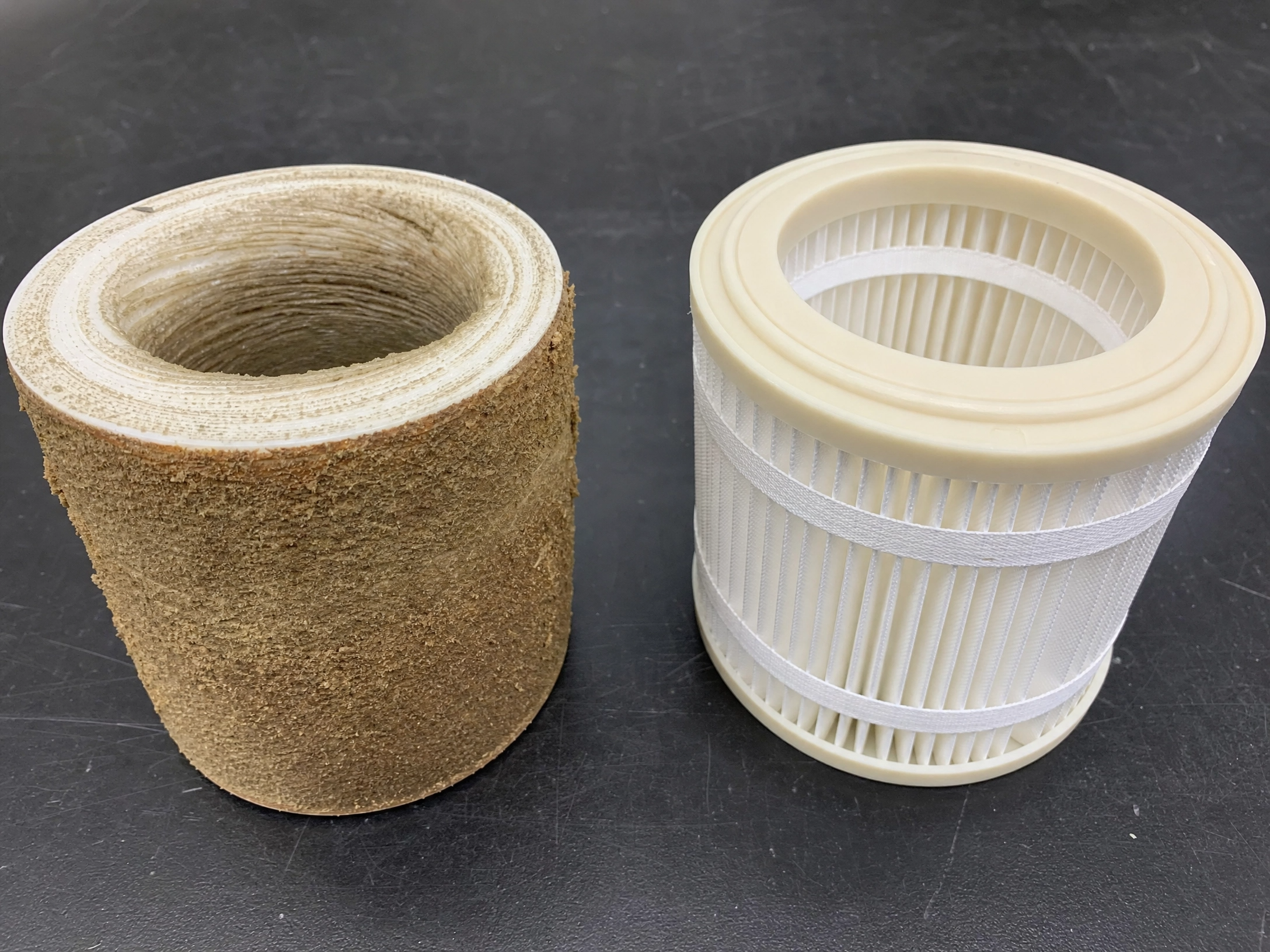
Winds polypropylene fibers around a core, creating gradient density: loose exterior, tighter toward center. Performs well with low, consistent solids loading. Under high solids or high velocity, the outer layer loads quickly — "surface blinding" cuts service life short before total media exhaustion.
Pleated
Flat filter media folded into accordion pleats around a core, significantly increasing effective filtration surface area. Distributes solids load more evenly; reaches terminal differential pressure only after full pleat surface engagement — longer service life under high solids load.
Spun is reasonable when:
- Solids loading is low and consistent
- Flow rate stays within low-flow rated range
- Protecting non-critical equipment (not RO, not food contact)
- Unit cost drives procurement
Pleated is better when:
- Solids concentration is moderate to high or variable
- Flow rate reaches mid-to-high rated range
- Protecting RO membranes, carbon blocks, or food-contact equipment
- NSF/ANSI 61 or food-contact compliance required
Nominal ratings indicate approximate particle size capture — some particles at or near rated size may pass. Absolute ratings indicate particles at or above rated size are retained to defined efficiency (commonly 99.9%+). For downstream protection (RO pre-treatment, food/beverage, pharmaceuticals), absolute-rated pleated cartridges at the specified micron are correct.
Sediment filtration must precede carbon block filtration — not interchangeable. For RO systems, the standard sequence is: sediment → carbon → RO. Carbon Block Cartridges — NSF Chlorine Removal and RO Protection →
Whether the housing uses spun or pleated cartridges, differential pressure — not a time-based schedule — is the correct changeout trigger. An inlet gauge and an outlet gauge, one on each side of the housing, give a direct reading of actual cartridge loading at current operating conditions. At approximately 15 PSI differential, or the cartridge manufacturer's stated terminal DP, initiate changeout. When to Replace Industrial Filter Cartridges — The Differential Pressure Rule →
Full specification framework for the complete system.
The peak-flow sizing calculation that prevents premature blinding.
Complete RO pre-treatment sediment + carbon specification.
When flow rates push past cartridge housing capacity.
FST and FSD series housings for sediment and carbon pre-treatment.
Are pleated cartridges always better than spun cartridges?
No. Spun graded-density works when solids loading is low and cost matters more than labor. Pleated is usually stronger with moderate-to-high loading or variable conditions.
Should sediment filtration come before carbon block filtration?
Yes. Sediment stage removes particulate load before it blinds the carbon block surface.
What is the right changeout trigger?
Differential pressure for both types. At approximately 15 PSI differential (or manufacturer specification), initiate changeout.
When does absolute micron rating matter?
For downstream equipment protection: RO pre-treatment, food/beverage, pharmaceuticals. Nominal ratings may allow particles at stated size to pass.
Get the right cartridge media type, not just micron rating
Ready to buy or need a fast answer? Call, text, or email James directly — (559) 395-5500 · james@libertyces.com.